Call Us Today! (703) 589-3192

The 24-Hour Kitchen Strategy: Coordinating Hood Maintenance Without Stopping the Line
Published on February 27, 2026
When your kitchen never closes, maintenance becomes a challenge of coordination. We explain how to handle professional degreasing in 24-hour facilities without stopping the line.

Back To Blog
Intro
For most restaurants, the “Night Shift Advantage” is the go-to solution for maintenance. But what happens when your doors never close? In a 24-hour diner, a busy hotel kitchen, or a high-volume hospital cafeteria in D.C., there is no “after-hours.” In these environments, the exhaust system is under constant thermal stress, and grease accumulation never takes a break. Coordinating a professional hood cleaning in a 24-hour kitchen requires a specialized “The Line Must Move” strategy. It is a high-stakes dance that balances mandatory fire safety with the non-negotiable demand of continuous food service.
The “Zone-by-Zone” Sectional Approach
The most effective way to clean a 24-hour exhaust system is through sectional isolation. If your kitchen has a long hood line with multiple exhaust fans, a professional team can section off one area at a time. By using heavy-duty, fire-rated plastic curtains and temporary baffles, technicians can “box out” a specific zone for degreasing while the other side of the line remains operational. This requires precise coordination with the Executive Chef to move high-production prep to the “live” stations while the maintenance team works on the “offline” stations. This “zone-by-zone” method ensures that the fire code is met without the restaurant ever losing its ability to serve guests.
Utilizing “Low-Tide” Windows for Rooftop Work
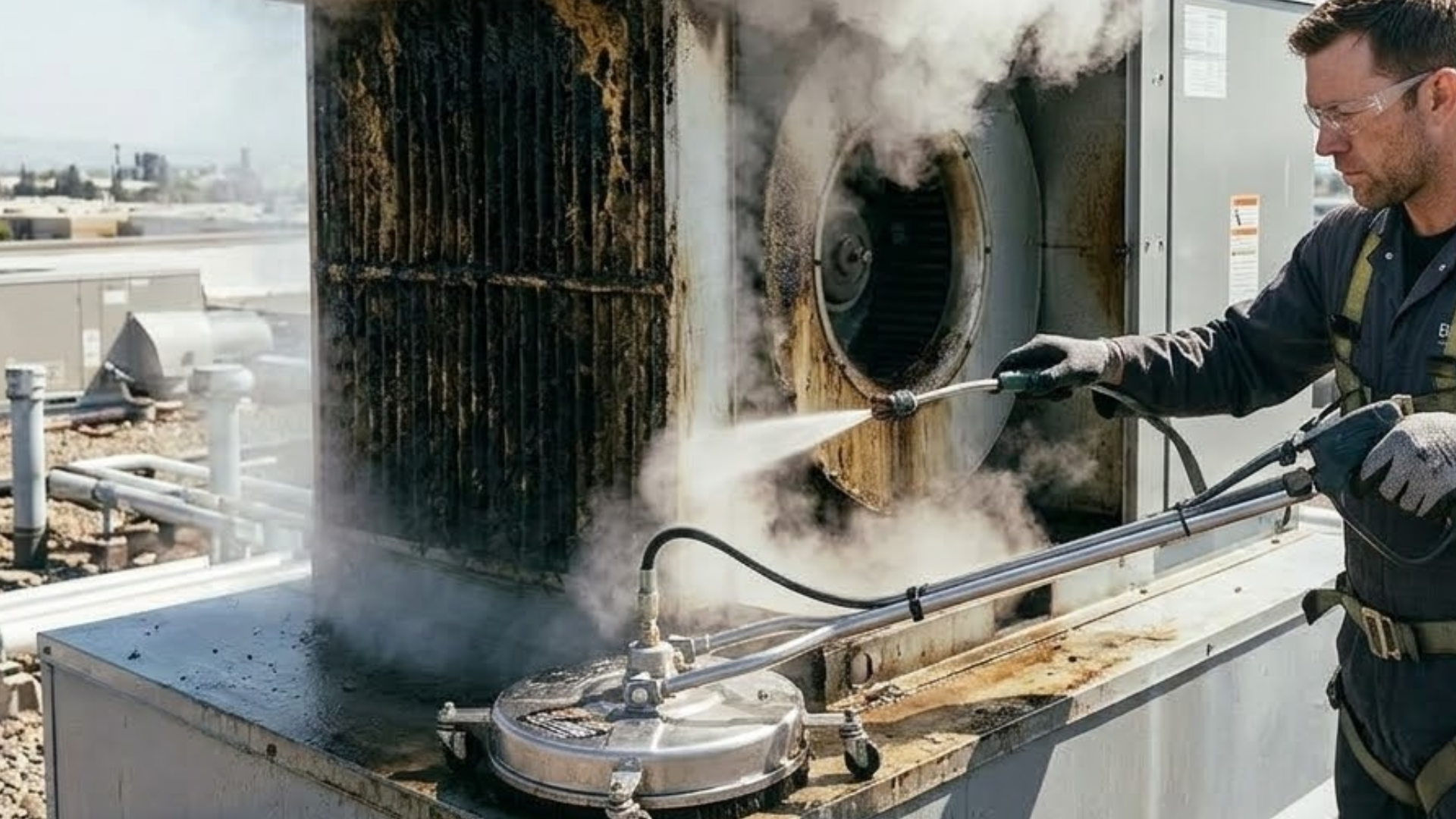
Even in a 24-hour kitchen, there are natural ebbs and flows in production—the “low-tide” windows typically found between 2:00 AM and 5:00 AM. A professional hood cleaning crew uses these windows to perform the most disruptive work, such as shutting down the rooftop fans. In a 24-hour operation, the fan cannot be off for long before heat and smoke begin to back up into the facility. Technicians must work with extreme efficiency, often doubling the size of the crew to ensure the “fan-off” time is minimized. By syncing the rooftop service with the quietest hour of the morning, the impact on the kitchen’s ambient temperature and air quality is kept to a minimum.
The Logistics of Safety and Sanitation
When maintenance happens alongside food production, the standards for “containment” must be absolute. In a closed kitchen, a small splash of water is an easy fix; in a 24-hour kitchen, it is a potential health code violation. Professional cleaners in these environments utilize advanced “funneling” systems that capture 100% of the wastewater and grease, directing it straight into sealed collection containers. Every square inch of the work zone is triple-wrapped to prevent cross-contamination. This level of precision allows the cleaning team to work just feet away from active prep stations, maintaining a “sterile” barrier between the industrial cleaning process and the culinary team.
Conclusion
Operating a 24-hour kitchen is an endurance sport, and your maintenance strategy must be just as resilient. You no longer have to choose between a fire-safe kitchen and an open one. By implementing a sectional cleaning strategy and utilizing specialized containment techniques, you can maintain “bare metal” standards while your chefs keep the line moving. In the fast-paced D.C. food scene, coordination is the ultimate key to success—and a professional hood cleaning partner who understands the 24-hour rhythm is your most valuable asset. Keep the lights on, the fans spinning, and the grease out without ever missing a ticket. To learn how after-hours cleaning minimizes downtime, CLICK HERE.
Frequently Asked Questions
How can a 24-hour kitchen stay compliant without closing?
We utilize a “sectional cleaning” approach. By isolating specific zones of the exhaust system and using specialized curtains and containment, we can clean one section of the hood while the other remains operational, ensuring you never have to fully shut down.
Does cleaning during the night shift cost more?
While some services charge a premium for “after-hours” work, a professional partner specializing in 24-hour operations views this as standard procedure. The real cost-saving comes from the fact that you don’t lose any revenue from cancelled shifts or closed doors.
Is it safe to cook while hood cleaning is in progress?
Yes, provided the cleaning team uses professional-grade containment systems. We ensure that no chemicals or water runoff interfere with the cooking line, allowing your staff to continue working safely in a designated “live” zone.
How often should a high-volume, 24-hour kitchen be cleaned?
Because these kitchens operate three times longer than a standard 8-hour establishment, grease buildup happens rapidly. Depending on the volume and type of cooking (like wood-fire or heavy grease), we typically recommend a monthly or bi-monthly cleaning schedule to stay within NFPA 96 standards.
Recent Posts
May. 08, 2026
Rooftop Exhaust Fan Cleaning: The Most Overlooked Part of Your Hood
May. 01, 2026
Can Insurance Deny Claims if Your Hood System Isn’t Cleaned?
Apr. 24, 2026
What Fire Marshals Look for During a Kitchen Exhaust Inspection
Apr. 17, 2026
How Often Should Commercial Kitchen Exhaust Systems Be Cleaned? (NFPA Guidelines Explained)
Apr. 10, 2026